Indie Innovations
Groundbreaking mechanics born in bedrooms and garages that changed the entire industry.
Time Manipulation
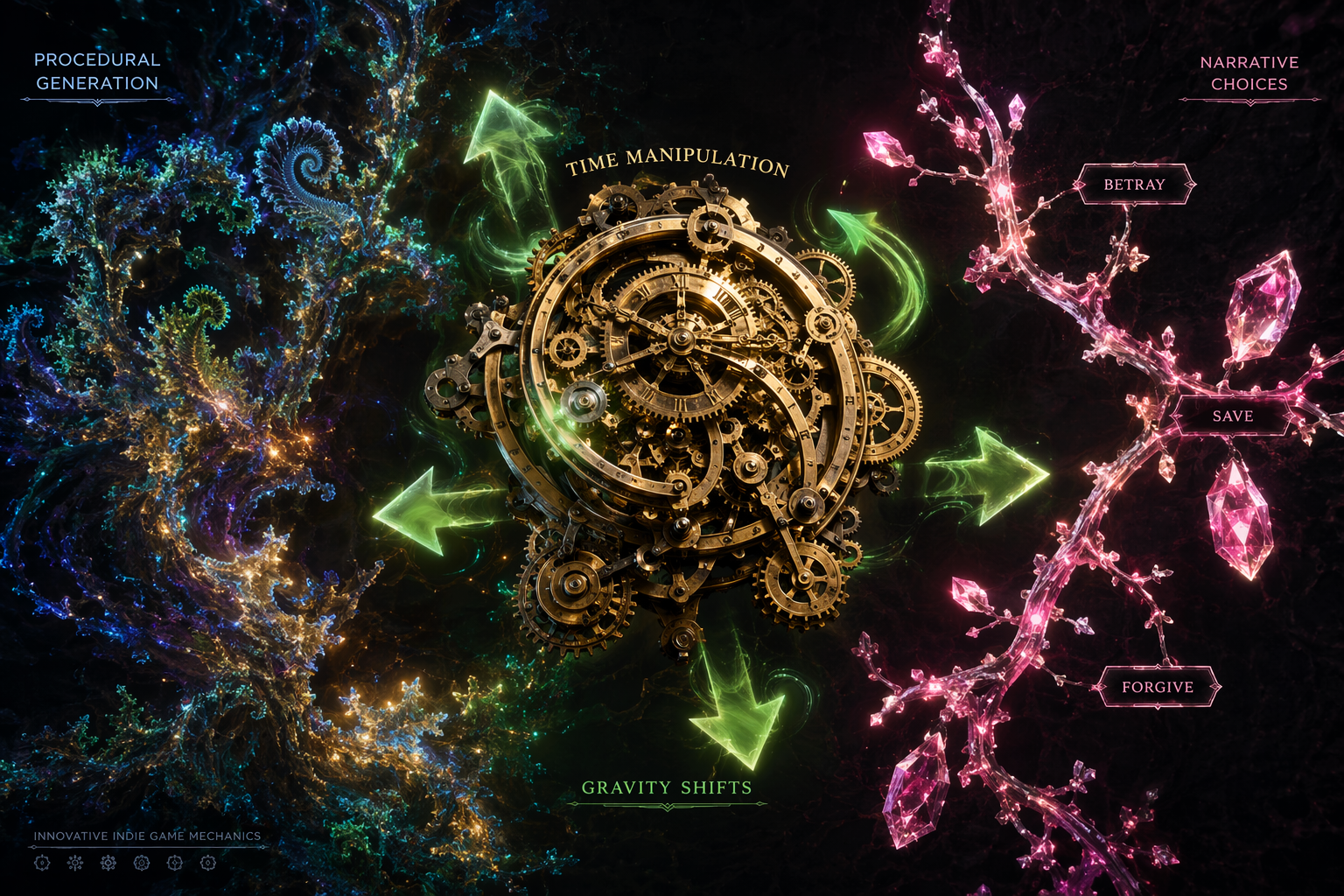
Braid (2008)Jonathan Blow's Braid turned time reversal from a gimmick into a core puzzle mechanic. Each world introduced a new rule about how time behaves — time flows with movement, objects exist outside time, shadows replay past actions. It proved that a single mechanic, explored deeply, could sustain an entire game.
Permadeath as Progress
Spelunky (2008/2012)Derek Yu's Spelunky popularized the modern roguelike: procedurally generated levels, permanent death, and knowledge as the only persistent upgrade. Every run teaches something new. Death isn't failure — it's curriculum.
Narrative as Mechanic
Undertale (2015)Toby Fox made the act of playing — fighting or sparing, saving or resetting — part of the story itself. The game remembers your choices across saves. Characters break the fourth wall not for comedy, but for genuine emotional weight.
Emergent Sandbox
Minecraft (2009/2011)Markus "Notch" Persson created a world where every block is both material and canvas. No objectives, no score — just infinite creative possibility. The mechanic is the world itself: mine, craft, build, survive.
Movement as Music
Crypt of the NecroDancer (2015)Brace Yourself Games fused rhythm gameplay with dungeon crawling. Every action must happen on the beat. Movement becomes dance, combat becomes choreography, and the soundtrack isn't background — it's the game's clock.
Deckbuilding + Roguelike
Slay the Spire (2017)MegaCrit combined card game deckbuilding with roguelike structure. Each run builds a unique deck from random offerings. The innovation: your "character build" is constructed card by card, creating infinite strategic variety from simple components.
🎯 Key Insight
Indie developers innovate by constraint. Without massive budgets for graphics or marketing, they must innovate mechanically. The result: ideas so strong they reshape the entire industry. Every major genre shift of the last 15 years started in a small studio.